
Cannes Lions 2025 & the HoldCo Reckoning:
Why the Agency Model Is Breaking
In 2025: The parties are still loud. The problems are even louder.
Each June, the ad world descends on the French Riviera for a week of rosé-soaked panels, yacht parties, and back-patting creativity. But this year at Cannes Lions 2025, something felt different.
The mood was uneasy. Conversations were quieter. And behind the curated Instagram posts, real questions echoed through the Carlton lobbies:
Are we watching the final chapters of the holding company era?
The Agency Model Is Buckling
Global agency holding companies are consolidating at a record pace. And all of this comes at a time when big agency holding companies are already under pressure. WPP, for example, lost two major accounts in the first half of 2025. Publicis and Omnicom are seeing slower growth in key global sectors.
Budgets are tighter. Trust is wavering. And clients are getting smarter - asking harder questions about what their marketing dollars actually deliver.
Omnicom's acquisition of Interpublic made headlines, forming the world’s largest ad agency group—but also triggering layoffs, leadership reshuffles, and legal scrutiny.
WPP continues to restructure, shedding layers of leadership while its stock and morale waver.
Publicis, once seen as the laggard, is suddenly positioned as the most stable of the bunch — but even its CEO admitted Cannes was "less celebratory" this year.
Yet somehow, the excess continues:
$1,200-a-night yachts turned into floating meeting rooms
Rosé brunches that rival client QBR budgets
Private performances from global music artists
Branded lounges on the French Riviera with little ROI insight
Thousands of dollars spent to win trophies no customer will ever see
The True Cost of Attending Cannes
Let’s strip away the filters and influencer glow. Here’s a line-by-line look at the cost of sending an agency team to Cannes 2025:
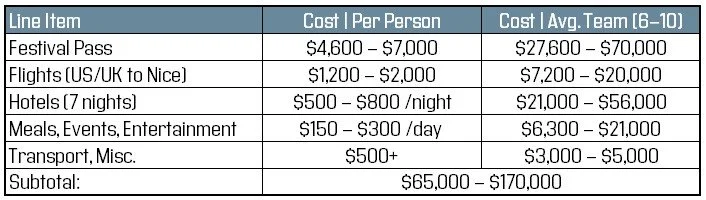
Now layer in the extras:
· Award entry fees: ~$600/entry (many agencies submit 25–50)
· Custom case study videos: $5K–$25K each
· Co-branded parties or villa dinners: $15K–$100K+
· Yacht rentals: $10K–$30K per day
· Beach sponsorships (e.g., WPP Beach): $250K–$1M
Many large agencies send dozens of people. One major network was rumored to have spent over $1.2 million on Cannes alone this year. Not on behalf of clients — but to raise their own profile.
Add to that AI upheaval, performance pressure, and an FTC investigation into competitive practices, and it's clear: the model that built Madison Avenue is cracking.
Clients Aren't Panicking. They're Prioritizing.
As the excess continues, many clients aren’t panicking. In fact, some barely blink. When Campaign asked about the industry’s glitzy presence at Cannes, Publicis CEO Arthur Sadoun bluntly stated, “Clients don’t care that much.”. He’s not wrong - but maybe not in the way he thinks.
That might be true for a few deep-pocketed global brands. But for most brands today — especially those watching margins, growth metrics, and marketing efficiency — the question isn’t just who’s footing the bill, it’s what are we really getting back for it? Those clients are watching. And they’re not amused.
Brands care about outcomes. They care about clarity. They care about budgets that go toward real work—not award show booths, inflated timesheets, or five layers of account management. Most marketers we know are being asked to justify every dollar, and they’re asking their agencies to do the same. And increasingly, they’re choosing smaller, more nimble firms that skip the bloat and get to the point.
What Clients Don’t See (But Still Pay For)
Who Really Pays? Ultimately, clients do.
This isn’t a dig at creativity. Cannes has a history of showcasing some of the best ideas in marketing history. But the costs have become performative—a shiny distraction from the real work that drives growth.
These costs rarely show up as itemized expenses on an invoice. Instead, they’re absorbed into:
Agency overhead
Media markups
Production padding
Retainers that quietly include non-billables
So when a client is reviewing a new retainer or project scope, they’re not just paying for campaign strategy. They’re often covering the soft costs that allow an agency to submit, travel, network, and celebrate — all under the banner of "industry leadership."
The issue isn’t that agencies attend. It’s how they fund it. Most clients don’t know they’re underwriting it.
The ROI Illusion
Let’s flip the lens. Imagine a CMO being asked to explain to their CFO that part of last quarter’s agency retainer helped fund a branded beach bar and private yacht party in the South of France.
There’s no shame in celebration. But when marketing budgets are under constant pressure to show return, it’s worth asking: Where’s the return on investment for the client?
Most brands don’t benefit directly from their agency’s presence at Cannes. In many cases:
The campaign that won the award has already been sunset.
The client didn’t approve, or maybe not even aware of the entry.
The case study was repackaged or exaggerated for awards season.
This year, a “Creative Data Grand Prix” went to a campaign later revealed to have submitted a doctored case study video. The irony couldn’t be sharper — and the signal couldn’t be clearer.
A Shift Is Underway
Mid-market brands, regional businesses, and challenger companies are rethinking their agency relationships. They want:
Strategy before media.
Accountability instead of opacity.
Long-term thinking over award-season theatrics.
As Digiday recently put it, consolidation is creating opportunity for boutique firms that serve "the forgotten middle" of the market. And that’s where the real change is happening.
What Comes Next
Agencies will continue to merge, shrink, and rebrand. Some will adapt. Many won’t.
But the marketers who come out ahead will be the ones who invest in clarity, not complexity. Who demand aligned strategy, not layered spin.
It’s not about being anti-agency. It’s about being pro-client and pro-outcome.
Let’s cut through the noise. If your agency model feels bloated, distracted, or disconnected from your business priorities, let’s talk.
See how we approach marketing differently: CLINTONSCOTT | Strategic Services